Robotics · Feedback control · Mechatronics

Muhammad Mustafa Khan

M.S. Student and Graduate Researcher in Mechanical and Robotics Engineering at the Gwangju Institute of Science and Technology (GIST)

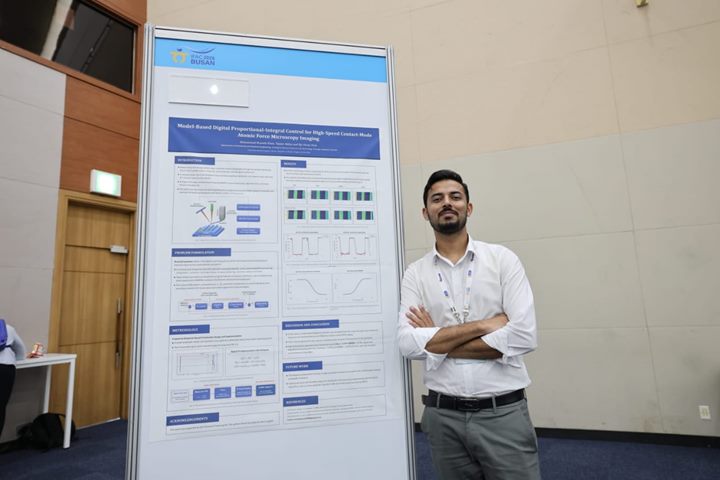
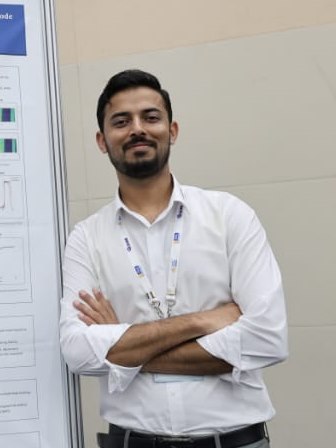
Muhammad Mustafa Khan standing beside his research poster at the IFAC World Congress in Busan.
23rd IFAC World Congress, Busan, August 2026

I develop feedback-controlled mechatronic systems that sense, process information and act in real time.

My current research at GIST focuses on system identification and embedded feedback control for contact-mode atomic force microscopy, with the aim of improving imaging speed and tracking performance. My broader interests include robotics and learning-based control of physical systems.

Dynamics & Control Lab, advised by Prof. Kyi Hwan Park

This portfolio is under development. Further project details and research updates will be added.

Selected work

Control, sensing and mechatronic systems

All four projects →

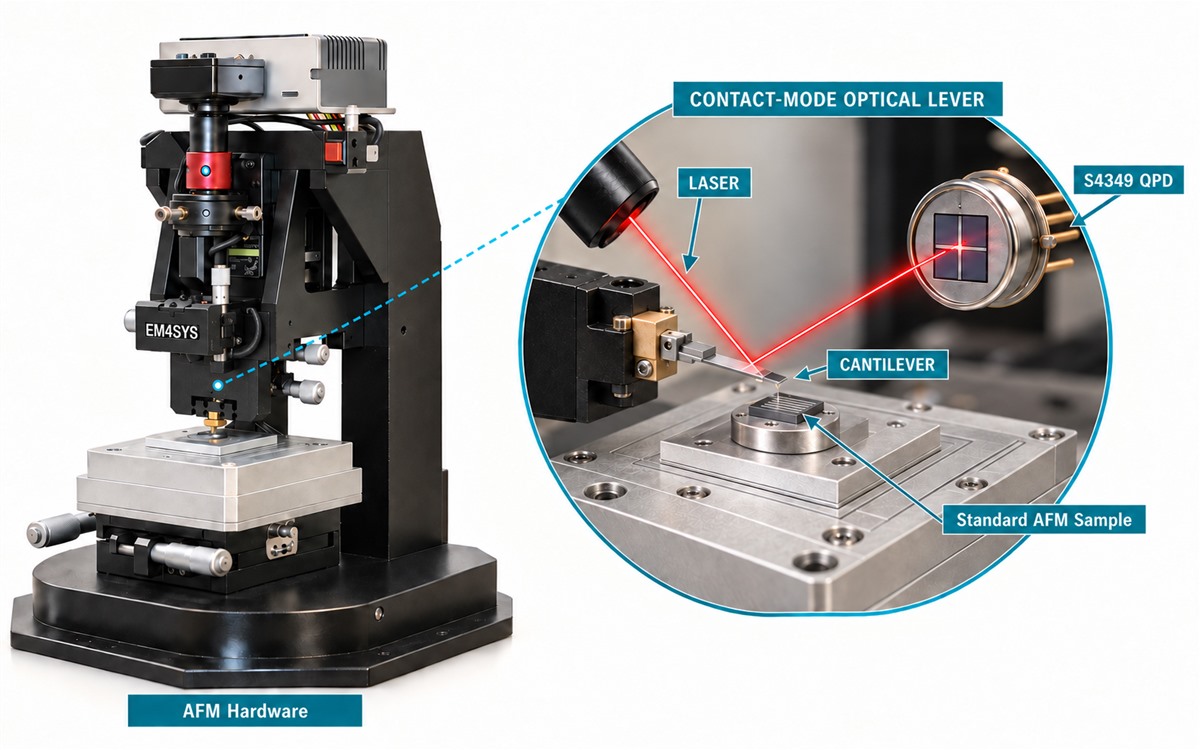
Concept illustrationThe complete AFM, optical-lever readout and embedded Z-axis feedback path. See the trace–retrace scans →

Current research · GIST · 2025–present

Model-Based Digital PI Control for High-Speed Contact-Mode AFM

Up to what scan frequency do the forward and backward topographies of a contact-mode AFM remain consistent under digital PI control of the Z-axis?

ContributionSystem identification, controller design, STM32 implementation, analog front-end revision and imaging experiments within the laboratory project.

EvidenceTrace–retrace r ≥ 0.977 through 5 Hz; agreement degrades at higher scan rates.

  • System identification
  • Embedded control
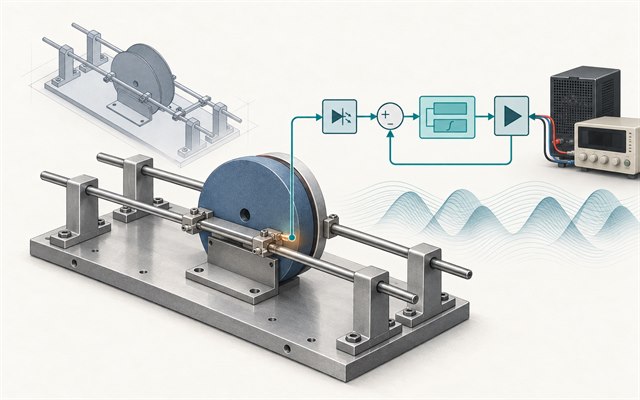
Concept illustrationThe built stage, current drive and analog feedback loop.

Research project · GIST · Winter 2025–26

Voice-Coil Actuator Positioning

A single-axis voice-coil stage has no restoring spring, so the plant integrates twice and supplies no phase lead of its own.

My roleBench designed in SolidWorks and built, current drive, identification and six analog compensators.

EvidenceSix compensators built and tested; lead compensation retained after bench evaluation.

  • Frequency response
  • Analog control
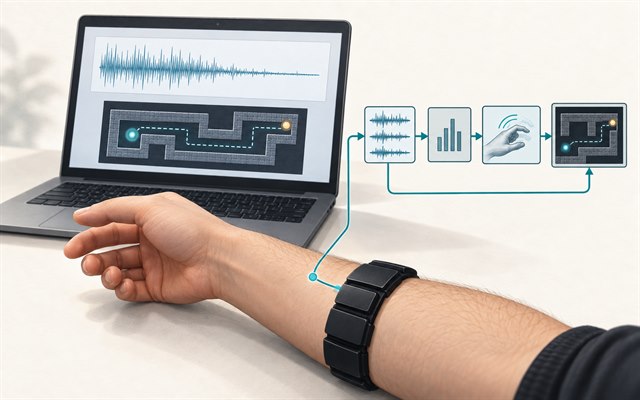
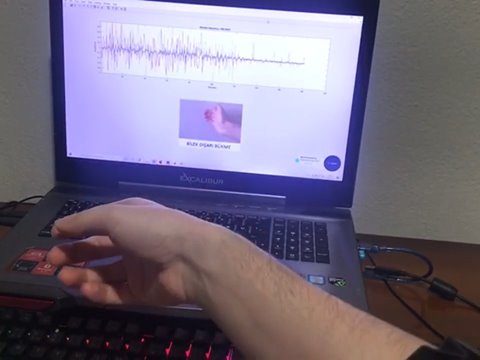
Concept illustrationMuscle activity becomes a real-time interactive command.

Research project · NUST · 2022–2023

Real-Time sEMG Rehabilitation Interface

Eight channels of forearm sEMG have to become an estimate of intended hand state fast enough for a person to steer an interactive task.

My roleAcquisition and feature pipeline, classifier comparison and deployment, three task interfaces, and the evaluation protocol.

Evidence150 ms classification window, online interfaces at one to three degrees of freedom, and the MUSED-I dataset.

  • Biosignal processing
  • Real-time inference
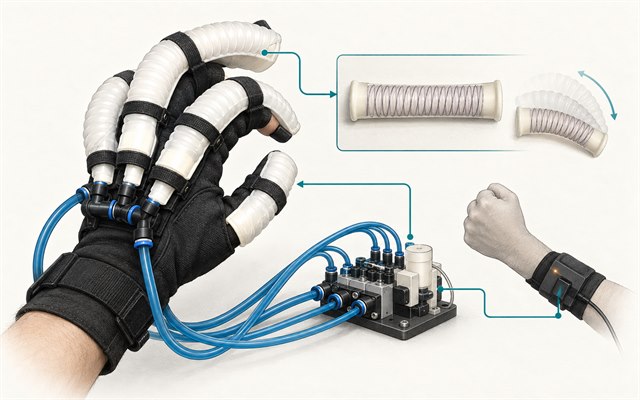
Concept illustrationThe wearable prototype, pneumatic drive and intended control link.

Team project · NUST · 2022–2023

REHABOTICS Pneumatic Soft Robotic Glove

A wearable rehabilitation glove needs actuators that bend where a finger bends, built from material and constraint rather than joints.

My roleThree actuator geometries, ANSYS analysis, soft-lithography fabrication and the pneumatic drive.

EvidenceBench-measured 120–180° flexion per actuator segment at 100 kPa. Functional hand performance was not assessed.

  • Soft actuators
  • Pneumatic control

Research interests

Three directions, at different stages

Precision mechatronics and feedback control

Identifying a physical plant from measurement, shaping a loop against its real resonances, and implementing that loop where saturation, quantisation and finite sample rates apply.

Current focus — AFM Z-axis, voice-coil stage

Human–machine sensing and rehabilitation interfaces

Acquisition, feature extraction and online inference on biosignals, evaluated as interfaces a person actually steers rather than as offline classification scores.

Established through prior research — sEMG interfaces, soft glove

Learning-enabled monitoring and embodied systems

Unsupervised models built on measured machine and human signals, and where that leads: control that improves from physical interaction rather than from a model alone.

Developing direction — not yet a research contribution

Research outputs

Posters, datasets and open artifacts

Muhammad Mustafa Khan beside the AFM control poster at the IFAC World Congress in Busan.

Poster presentation · 2026

Model-Based Digital Proportional-Integral Control for High-Speed Contact-Mode Atomic Force Microscopy Imaging

M. M. Khan, T. Abbas and K. H. Park

23rd IFAC World Congress, Busan, Republic of Korea, 23–28 August 2026. Presented by M. M. Khan.

Live sEMG gesture classification running on a laptop during a recording session.

Dataset · 2023

MUSED-I: Multi-Gesture Surface Electromyography (sEMG) Dataset for Stroke Rehabilitation

M. M. Khan, M. Farhan, A. Shahzad, H. S. Qarni, A. Waris and O. Gilani

IEEE DataPort, August 2023 · doi:10.21227/04zq-yz45

About

Background

Before joining GIST, I studied mechanical engineering at NUST, where my research included real-time surface electromyography (sEMG) interfaces and fibre-reinforced pneumatic actuators for rehabilitation. I now conduct research in the Dynamics & Control Lab under Prof. Kyi Hwan Park.

My research approach combines experimental system identification, controller design and embedded implementation. I evaluate models and controllers through hardware experiments, with particular attention to sensing, signal conditioning and real-time operation.

Full record in the CV

Education

M.S., Mechanical and Robotics Engineering — GIST, 2025–2027 (expected)
B.E., Mechanical Engineering — NUST, 2019–2023

Methods

System identification and loop shaping · real-time embedded control · instrumentation and analog signal conditioning · feature extraction and applied machine learning